OK... let me begin with a couple of facts.
I am pro-choice. I have no idea why or how that gets conflated with "pro-abortion." I don't know anyone who is "pro-abortion." Indeed even the abortion providers with whom I'm familiar would like nothing better than to see the procedure disappear.
Being pro-choice is a stance based in my understanding of my faith. It is by no means in conflict with my commitment to following Jesus.
Given that lots of folk are writing about safe and legal these days given the current situation, I want to write a little about "rare." Again, let me been with the assertion that everyone I know who is pro-choice wants abortion to become rare. I'm less sure that is the case with many of those who call themselves "pro-life" but who I would rather call "anti-choice."
So what are the conditions that allow that to happen... Women who get pregnant want to be pregnant. They see a way forward that truly involves life.
So how do we get there... first the easy steps.
We make birth control easily available to all. I remember being shocked when one of my young church members reported going off to college and being confronted by bowls of condoms in his dorm common areas. I now think it was a wonderful idea. Perhaps such a bowl should be in every high school rest room. But condoms must not be the only method freely and easily available. Make other methods freely and easily available to young girls.
We make sex ed a requirement for ALL youth beginning before they reach puberty. No parental op out. Get rid of the stupid abstinence only programs. One of my clergy friends used to say "abstinence works... until it doesn't." There is clearly a reason why there are large numbers of young girls from evangelical families seeking abortions. They have been indoctrinated with the idea that abstinence is the only option... so they don't understand or have birth control available. Too often they end up with a pregnancy for which they are unprepared and for which they certainly have not planned.
Work to teach boys that they are responsible for unplanned pregnancies and put teeth in that responsibility.
Now the more difficult ones...
Provide supports for mothers and young children. This would involve free day care, support for the mother so that a pregnancy does not derail her entire future, food, shelter, housing supports where needed, enhanced supports for special needs children. We see again and again that economic pressure, poor education, and reduced options lead to higher abortion rates while societal supports for women inevitably pushes the abortion rate down. There are reasons that poor women have more abortions. We can remedy that.
Some time ago I read an article written by an anti-choice mother of a child with Down's Syndrome. She remarked that one sees fewer and fewer children with Down's Syndrome and that the vast majority of parents ho learn of that marker in a pregnancy seek an abortion. She cited both the loss that entails to society and the difficulties one faces as a parent of a child with those issues. She was especially articulate regarding the fears she had as a parent, worrying about her child's future should something happen to her and her husband. She then talked of a trip she made to Northern Europe - an area where abortion is less stigmatized than in the US and much more available. She was surprised to see what she perceived as significantly more people with Down's Syndrome. As she enquired, she quickly saw that the parents there had much less anxiety than parents of Down's Syndrome children in the US. They felt sure that should something happen to them, the general society would be there to make sure the child was not abandoned. She described what she saw as a clear method to lessen abortions of fetuses with Down's Syndrome markers - have strong societal and governmental support for the children and their parents. That gave the parents the luxury of saying "yes," knowing they would not be forced to deal with all of the pressures on their own.
We can make abortion more rare. It involves political choices that we can make if we are really interested in making abortion more rare as opposed to exerting control over women's bodies and autonomy.
Wednesday, May 22, 2019


Wednesday, March 20, 2019
New Car Day
I live 35 miles from my work. That means I make a significant commute each day. For 14 years I drove an '02 Volkswagen GTI and averaged about 32 MPG. That added up to a BIG carbon footprint.
As much as I loved that car, when it died of old age (the transmission died at 260K miles), we wanted something with less carbon footprint that would still cover the various needs the GTI did - specifically carrying my music gear.
We bought a Ford C Max Energy (plug in hybrid). With careful driving and use of the electric motor, the C-Max allowed me to cut my gasoline use to one third of my previous use. Big step forward!
At the same time, we've had our eyes on solar panels for our home. We live in a place where electricity is among the most expensive in the nation and where the sun shines a lot. That adds up to a very attractive place for solar panels. Unfortunately we live in a condo with a shared roof. Most condo homeowners associations do not allow solar panels. Ours does... but then we had difficulty finding a vendor who would install on a shared roof. Eventually we found one and got 16 solar panels installed on the roof.
My spouse's car was also getting long in the tooth - an '03 Honda Accord with 250K miles. We decided to sell the Honda and get an all electric for me to use in commuting. We were really excited
about the recently released Arcimoto FUV. Indeed, we still have a small deposit on one. We got to test drive one a few weeks ago and the descriptor is right on target. It is fun. The downside is that while it would be a great commuter vehicle, I'm not sure I could carry my bass rig and pretty positive my acoustic guitar and rack would never fit. And that is without my spouse. If she's in the vehicle too, I think a gallon of milk is about all we can carry beyond the two of us. (Did I say it is fun?)
 |
| Arcimoto FUV |
That moved us to the back-up plan.
Like a number of other manufacturers, Fiat began building an all electric vehicle - the 500e - in about '13 to lower
their fleet gasoline mileage to meet new government requirements. Unfortunately the perception was that the car was still over priced even after the tax rebates so they weren't selling. To remedy this, Fiat put them on the road on ridiculously inexpensive low mileage leases - $99 a month. The current lease on the same car is $149 a month for a low mileage lease. Each year since '16 that has meant that a bunch have come off lease and are available on the used market. The '16's are currently coming off lease now, are priced very attractively, and most have low mileage. The car is rated at 84 mile range with a 20 KWH battery. The back seat is only useful for stuff or small children but you can fit groceries or a bass and amp plus a second person.
.jpg/800px-2016_Fiat_500e%2C_Silver_Lake_(rear_left).jpg) |
| image from wikimedia, taken by mr.choppers |
So... we went with the back-up plan. We're collecting solar energy to charge it at home and my work allows me to plug in there so thus far the range is fine for me. We do have the plug in hybrid for longer trips or when we need more space. Most of all, my carbon footprint is waaaayyyy down and we anticipate we'll only need to add any gasoline about every month or month and a half under normal use.
The Fiat is also really fun to drive. The heavy battery mounted down low gives it a low center of gravity which makes the car stick to the road like a go cart. Electric motors tend to have more torque than their gasoline powered cousins so the little guy has serious get up and go... (much more than the gasoline powered 500). The temptation is to drive it like a sports car... but if you do you can almost watch the charge level on the battery drop as you accelerate. So even though it could be a lot of fun to drive, I find myself driving like an old man (no smart comments thank you very much) and instead of being proud of my time in an autocross, I watch my range and strive to get more distance out of a charge.
I am considerably more aware at how few charging stations are out there, how many that are there are not functioning, and worst of all, how often a non-electric car is parked in those spots. ARRRHHH
Cory & the Seventh Story - a book review
I’ve been writing book reviews for some time but this review is unique… I’m reviewing a Cory & the Seventh Story by Brian MacLaren and Gareth Higgins. A disclaimer is important. Both Brian and Gareth are acquaintances of mine and I have the deepest respect for them both.

So how does a 60 something year old man review a children’s book? I read it to my grandchildren, in this case, particularly to my 5 year old grandson who is a particularly good children’s book listener. Kiddo enjoyed the book and loved to join in with Owl, “who, who, who will help us?” He couldn’t distinguish between the 6 dysfunctional stories and I’m not entirely sure that he got the idea that the stories we tell ourselves shape the way we live together, but he did get the idea that we can love and welcome one another and that is indeed, a better way to live together.
Like all good children’s stories, this one is also written to be overheard by the grownups reading the story to their littles. This one does that well and the story of Cory’s village presents very real concerns in a way that gets underneath some of the defenses and pre-conceptions of the adults present. I do have to say that the six dysfunctional stories are not as distinguished from one another as they might be and had I not heard one of Brian’s talks on the 7thstory, and/or read the companion adult book, I may have missed one or two. Still, the alternative way of living and being is there, calling to the reader and the one being read to.
Kiddo’s mother was very excited about the book and has also read it to him more than once.
All in all, the book does require a bit of maturity from the listener and even then needs some discussion… but it is a good discussion starter.
Tuesday, November 06, 2018
This is Hard
This political situation is the hardest one I’ve experienced in my adult life.
There has been a lot of talk about reaching across barriers and the need to break down the divisions that are so damaging in the US right now... I saw a meme the other day that said something to the effect of “I can still talk with you after the election even if you didn’t vote as I did. That’s what being an adult means.”
Here’s the thing... I’m not sure about that. It feels to me that the election happening today is not just about opinions or two competing ideas regarding how to work for the common good. It really does look to me that the actions of the current administration are evil. I really see no reason to even suspect that they (he) have the common good in mind. And the GOP is complicit in that.
If somebody votes for that party, it seems that they are either choosing to close their eyes to the evil or supportive of it. I don’t see any other option. I really don’t know how to reach out under those circumstances.
There has been a lot of talk about reaching across barriers and the need to break down the divisions that are so damaging in the US right now... I saw a meme the other day that said something to the effect of “I can still talk with you after the election even if you didn’t vote as I did. That’s what being an adult means.”
Here’s the thing... I’m not sure about that. It feels to me that the election happening today is not just about opinions or two competing ideas regarding how to work for the common good. It really does look to me that the actions of the current administration are evil. I really see no reason to even suspect that they (he) have the common good in mind. And the GOP is complicit in that.
- They have abandoned traditional conservative values. I’m not a conservative but I appreciate the place that viewpoint needs to have in our national discourse.
- They have allowed Trump to tear down democratic institutions.
- They have been willing to sacrifice anything and everything for power.
- Like Trump they have been willing to abandon truth without the slightest hint of discomfort.
If somebody votes for that party, it seems that they are either choosing to close their eyes to the evil or supportive of it. I don’t see any other option. I really don’t know how to reach out under those circumstances.
Wednesday, October 17, 2018
Making America Great Again: Fairy Tale? Horror Story? Dream Come True? - a book review
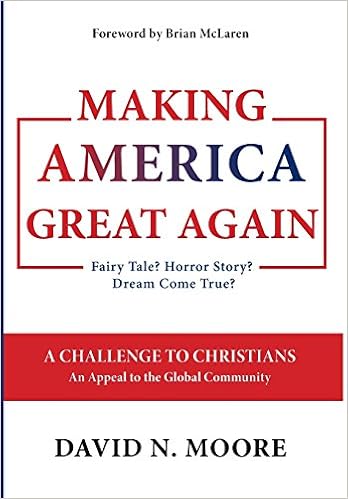 Let me begin this book review with a disclaimer. David Moore is a friend of mine. That does not disqualify me from reviewing his book. All I can say is that if I had not found the book meaningful and helpful, I would have remained silent. My simple review is that I find the book very, very important.
My second disclaimer is a personal one. I am a white, older, well-educated, middle class, male. My life is marked by privilege about which I am aware only when I choose to be. I grew up in the inner city, have leaned far to the left both culturally and politically almost all of my life. I am a Christian. Indeed, For part of my life I identified with the broader evangelical movement but I do not now and have not for about 30 years. I consider myself pretty woke... but as soon as I say that, I remind myself that I am a white, older, well educated, middle class male... and that brings with it a certain set of blinders.
I’ve read the book three times in the course of preparing to write this review. The first time I approached the book as David's friend. I found the book a wonderful and intimate sharing. I learned things about my friend that I suspect he would never have shared under other circumstances. This was all enhanced by the fact that my first go through was listening to the audio book, read by David himself. The second time, I tried to come at the book more objectively and read a physical copy of the book. I found a powerful and personal look through a lens that is not the one I have. It felt a bit more hard hitting than the first read. I think this experience was enhanced by the gravity of a hard back book in my hands... The third time was just to make sure I hadn’t missed something important. I allowed my earlier perspectives to meld a bit and went back and forth between the audio and the physical copies.
My biggest take-away of this book is the reminder that my experience of the church is not normative for all people... that my black friends, no matter how easily they seem to move in the same circles as I, always do so with an asterisk beside their name... and a sense of tension that “one of these things is not like the other.” I have always been aware of the degree to which race colors every experience in our culture including the church, but have not thought as critically as I have needed to about the exact meaning of that awareness in this particular instance. This book encourages me to do so. In response I have found myself talking with other black friends about the ways that race has impacted their experience of church. Had that been the only result of reading this book, it would have been well worth my time.
David’s story is personal. I suspect that it is also fairly universal for my black friends who move in the broader, white, church. It does resonate with the experiences of my friends with whom I talked after reading. The book is courageous and generous. It is prophetic and heartbreaking. David gives a gift to those of us who claim to follow Jesus by sharing his story and calling us to a deeper and more authentic walk of faith and to a community of awareness and caring.
If you know black folk who are part of the Church, this book will help you understand the tensions they likely feel. If you wonder how and why black evangelicals differ so vehemently from white evangelicals in the cultural debates of the time, this book will open the door a bit for you. If you assume that Church is one place where racism does not impact our way of living, this book tears away the bandages that hide the wounds. If you want to hear one honest man share his story and find your life both enriched and challenged by that life, read this book. If you're white, read this book. If you are a person of color, read this book. In every case, allow it to be an inspiration to share your experience of race in the Church and in the broader culture and a doorway to deeper understanding.
Disclosure of Material Connection: I received this book free from the author and/or publisher through the Speakeasy blogging book review network. I was not required to write a positive review. The opinions I have expressed are my own. I am disclosing this in accordance with the Federal Trade Commission’s 16 CFR,Part 255.
Tuesday, June 26, 2018
Shaming as a political tactic
We’ve all heard that three Trump administration officials have been either shamed into leaving restaurants or refused service over the past few days.
First a couple of observations...
They are not being singled out because of their political views. They are being singled out because of the reprehensible actions of the administration of which they are integral parts. That is a huge difference.
Their cases are being compared to the cases of a bakery and a florist denying service to gay couples by booth sides of the political spectrum, calling out hypocrisy on the other side because of their stands on the florist and bakery cases. The issues are not the same. Political views do not render one a protected class (remember it really isn’t about political views anyway) and businesses do have the right to deny service to patrons for any reason as long as it is not because they are part of a protected class. Second, The LGBTQ folk denied service are being denied because of who they are while the Trump officials are denied because of something they have done. Some on the right might argue that in both cases it has to do with the actions of the individuals involved and moral judgements, based on religious understandings are what is at stake. OK... if we give that, there is still a huge difference. The actions of the LGBTQ couples are private and have zero impact on the public sphere. Indeed, we have no idea whether any “actions” are taking place at all. There is no way to know whether or not the couple is sexually active or not. Finally making a cake for a couple or a floral arrangement has no real implication that the vendor is participating in actions that may or may not be happening. The actions of the Trump administration officials are very public. They have public consequences that impact all of us. And, as public employees, their actions are being done in the names of the public - you and me.
So... it is legal. It is morally understandable. It is politically understandable.
All that said, I do not know how I feel about these actions and Maxine Waters’ call to continue and increase the public shaming of Trump administration officials. Clearly, I think they should be ashamed. The actions of this administration are reprehensible. They are immoral. They are unamerican (and not only the immigration issues - they are literally working to destroy almost all of the institutions upon which this nation is built). Clearly I think they should be called out for their public actions... certainly at the voting booth and in the halls of political decision making but perhaps also publicly. Do they deserve to have that shaming and calling out intrude into their private lives? I don’t know. And how far down the food chain do we go? I saw a report that some lower level administration employees are even having difficulty getting dates when the potential partner finds out they work for the Trump administration.
The more I wrestle with these questions, the more depressed I become... that we have fallen that far and that we literally have given power to a political party that is actively working to destroy our democracy. Yes, I do believe that. I also find myself more and more feeling that the folk who are participating in that strategy deserve to be called out at every opportunity.
First a couple of observations...
They are not being singled out because of their political views. They are being singled out because of the reprehensible actions of the administration of which they are integral parts. That is a huge difference.
Their cases are being compared to the cases of a bakery and a florist denying service to gay couples by booth sides of the political spectrum, calling out hypocrisy on the other side because of their stands on the florist and bakery cases. The issues are not the same. Political views do not render one a protected class (remember it really isn’t about political views anyway) and businesses do have the right to deny service to patrons for any reason as long as it is not because they are part of a protected class. Second, The LGBTQ folk denied service are being denied because of who they are while the Trump officials are denied because of something they have done. Some on the right might argue that in both cases it has to do with the actions of the individuals involved and moral judgements, based on religious understandings are what is at stake. OK... if we give that, there is still a huge difference. The actions of the LGBTQ couples are private and have zero impact on the public sphere. Indeed, we have no idea whether any “actions” are taking place at all. There is no way to know whether or not the couple is sexually active or not. Finally making a cake for a couple or a floral arrangement has no real implication that the vendor is participating in actions that may or may not be happening. The actions of the Trump administration officials are very public. They have public consequences that impact all of us. And, as public employees, their actions are being done in the names of the public - you and me.
So... it is legal. It is morally understandable. It is politically understandable.
All that said, I do not know how I feel about these actions and Maxine Waters’ call to continue and increase the public shaming of Trump administration officials. Clearly, I think they should be ashamed. The actions of this administration are reprehensible. They are immoral. They are unamerican (and not only the immigration issues - they are literally working to destroy almost all of the institutions upon which this nation is built). Clearly I think they should be called out for their public actions... certainly at the voting booth and in the halls of political decision making but perhaps also publicly. Do they deserve to have that shaming and calling out intrude into their private lives? I don’t know. And how far down the food chain do we go? I saw a report that some lower level administration employees are even having difficulty getting dates when the potential partner finds out they work for the Trump administration.
The more I wrestle with these questions, the more depressed I become... that we have fallen that far and that we literally have given power to a political party that is actively working to destroy our democracy. Yes, I do believe that. I also find myself more and more feeling that the folk who are participating in that strategy deserve to be called out at every opportunity.
Tuesday, May 29, 2018
Sermons as Story Telling
Stories work. They have a way of getting past our intellectual defenses and impacting us on a gut level. That is why a good sermon almost always has a great story or three. For years I’ve occasionally preached sermons that are one single story, told from the viewpoint from a character, often in the Biblical narrative. I like to preach that style. There was a period when I did it a lot. The joke at my then congregation was, “Who is Roy going to be today?”
For a number of reasons I have done it less often at my current congregation and hadn’t preached a sermon in that style at all since we began videoing the sermons and putting them up on YouTube over a year ago. Well, I preached a 1st person sermon this past Sunday - Looking for Jesus. Here it is. Let me know what you think.
For a number of reasons I have done it less often at my current congregation and hadn’t preached a sermon in that style at all since we began videoing the sermons and putting them up on YouTube over a year ago. Well, I preached a 1st person sermon this past Sunday - Looking for Jesus. Here it is. Let me know what you think.
Tuesday, May 15, 2018
I’m Angry...
Yesterday the US opened its new embassy in Jerusalem. That is another post. What I’m really angry about today is that two “Christian” clergy were invited to pray at the dedication - Robert Jeffress and John Hagee. Not only are they fundamentalists but they represent a certain strain of fundamentalism that is actively hopping for and hoping to help institigate Armageddon. They believe that a war which will basically destroy the world is slated to begin in Israel and they want to see it happen. Of course, it also means that any Jews who do not convert to their brand of Christianity will go directly to Hell and not pass go along with everyone else who does not fit their definition of Christian.
Let me say this as clearly as I can. They want war to begin in Israel and they believe this step will help that to begin. They believe it is God’s plan for the horrors of war to come to that land and that people and they are excited to be part of making it happen. They have no political reason for wanting the embassy moved. They have no vision for how to get to peace, indeed, they do not want peace. Their desire is for a religious war. It is that simple. They are no better and no different than ISIS except they wear suits and ties and wield the power of the US state rather than small arms and suicide bombs.
Now, I don’t think Trump believes their twisted and radically unchristian theology. I doubt he even understands it. I don’t believe he even sees how playing into their hands may indeed be a self-fulfilling prophesy. I think he is just continuing his “I want to undo anything Obama did regardless of the cost” and a big part of that is playing to this sick, twisted, heretical sect who claim to be following the Bible. It is the worst blending of religion and state that I can think of in the history of this nation and we, along with millions around the world, will pay for it. Israel will pay dearly as it will help to bring war to their doorsteps and will help continue their path to a nation that either will no longer be a Jewish state or it will not be democratic because as Ehud Barack has said, this path leads to a place where Israel cannot be both.
Let me say this as clearly as I can. They want war to begin in Israel and they believe this step will help that to begin. They believe it is God’s plan for the horrors of war to come to that land and that people and they are excited to be part of making it happen. They have no political reason for wanting the embassy moved. They have no vision for how to get to peace, indeed, they do not want peace. Their desire is for a religious war. It is that simple. They are no better and no different than ISIS except they wear suits and ties and wield the power of the US state rather than small arms and suicide bombs.
Now, I don’t think Trump believes their twisted and radically unchristian theology. I doubt he even understands it. I don’t believe he even sees how playing into their hands may indeed be a self-fulfilling prophesy. I think he is just continuing his “I want to undo anything Obama did regardless of the cost” and a big part of that is playing to this sick, twisted, heretical sect who claim to be following the Bible. It is the worst blending of religion and state that I can think of in the history of this nation and we, along with millions around the world, will pay for it. Israel will pay dearly as it will help to bring war to their doorsteps and will help continue their path to a nation that either will no longer be a Jewish state or it will not be democratic because as Ehud Barack has said, this path leads to a place where Israel cannot be both.
Subscribe to:
Posts (Atom)


